
Booking for Two Still Means One Kart Each: A First-Timer's Guide to Street Karting in Minamihorie, Osaka
Booking for Two Still Means One Kart Each: A First-Timer's Guide to Street Karting in Minamihorie, Osaka
You've booked for two.
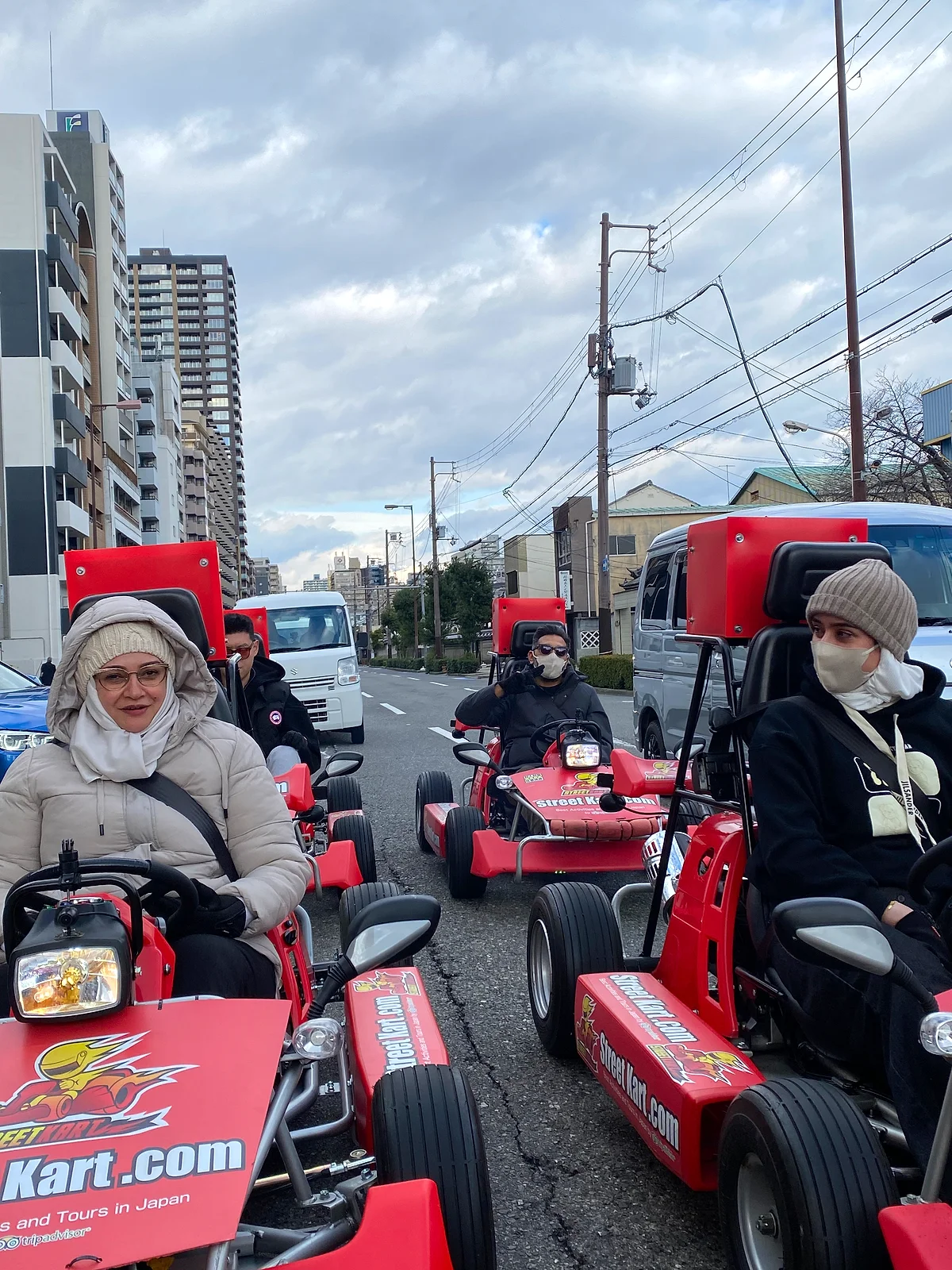
Street Kart runs guided tours, with a guide driving at the front of the group.
This article walks through the whole process in order, from booking to after the tour ends, so you know what to expect at each step. It also covers how to plan your time on a tight travel schedule and when to take photos.
Booking for Two Still Means One Kart Each
First, whether you'll be driving with other customers is something to ask Street Kart directly when you book.
Just as important: the karts are single-seaters, so nobody can ride as a passenger.
In Taiwan, when you head out with a friend on a scooter, one of you can just ride on the back. To Japanese visitors, the long rows of two-up scooters waiting at a Taipei intersection in the morning are one of the city's famous sights. Here, though, each of you drives your own kart. "He drives, I sit in the back and take photos" simply isn't possible.
So on the day, you drive your own kart, and the guide leads from the front.
Step 1: What the Two of You Should Check Before Booking
Before you apply, talk about whether both of you meet the requirements to drive.
The karts are single-seaters, so if only one of you qualifies, you can't join as a pair. Which driver's licenses are accepted depends on the country and the type of document. I can't tell you which ones will work, so both of you should check your own documents against the official driver's license page. See the official site for full details. The riskiest assumption is "Mine was fine, so yours probably is too." Just picturing a traveling couple finding out on the day that one of their licenses doesn't count is enough to give me a stomachache.
Next, the date. Weekends book up quickly, so if you want to drive on a Saturday or Sunday, book early. If you only have a few days in Osaka, see whether a weekday slot would work before you plan anything else. That saves you from reshuffling the rest of your schedule later.
You can book through Facebook, LINE, or email (booking@streetkart.com). When you apply, include the country that issued your license, the number of drivers, your preferred date and time, and the location. Ask for the meeting time and expected finish time while you're at it. For two people, listing the issuing country of each person's license clearly keeps the back-and-forth simple.
A word about language too. On the day, instructions are mainly in English. Whether you'll get help in Japanese or another language depends on the staff working that day, so there are no guarantees. If you're not confident in English, ask about it when you book. The website is available in 22 languages, including Traditional Chinese.
Step 2: Getting to the Minamihorie Shop and Planning Your Arrival
The Osaka shop is in Minamihorie, in Nishi Ward. The nearest station is Nishi-Ohashi on the Osaka Metro Nagahori Tsurumi-ryokuchi Line, about a 3-minute walk away. Yotsubashi Station on the Osaka Metro Yotsubashi Line is about a 5-minute walk. Shinsaibashi Station is about 12 minutes on foot, and Namba Station about 15.
A short detour: in Osaka, "Minami" (the South) refers to the Shinsaibashi, Namba, and Dotonbori area. Its counterpart is "Kita" (the North), around Umeda. Locals say things like "Let's go to Minami today," using it more like the name of a neighborhood than a direction. Minamihorie sits at the western edge of Minami, a little away from the bustle of Shinsaibashi on the map. Station names like "Yotsubashi" (Four Bridges) and "Nishi-Ohashi" (West Great Bridge) hint that this used to be a city of canals, which makes the map fun to look at on its own. ...Okay, back to the guide.
The shop has no parking, so please take public transportation.
Now, about planning your time.
A common mistake for traveling couples is packing too much in right before the tour. Osaka Castle in the morning, Kuromon Market for lunch, then straight to Minamihorie... With a plan like that, one small delay anywhere makes you late for the meeting time.
My recommendation is to block off everything from the meeting time to the expected finish time you confirmed at booking, then plan around it. Keep anything right before the tour within Minamihorie. The neighborhood is full of stylish shops and cafés and is often compared to Daikanyama or Ura-Harajuku in Tokyo. Arrive a little early, relax at a nearby café, then walk over to the shop. That bit of extra time also lets you take in your surroundings calmly at check-in.
What to wear depends on the season. Osaka summers are less "hot" than "steamy," and in winter the wind coming off the rivers can feel cold. Check the conditions on the official site in advance, including what happens if it rains.
Step 3: When You Arrive, Your First Words Can Be in English
Staff instructions are mainly in English. If you miss something, don't let it slide. Just say "Sorry, one more time please." Setting off without catching an explanation about driving is dangerous for you and for the people ahead of and behind you. If you're there as a pair, quietly checking with each other on what you understood is another good idea.
If you want to use a translation app, do it during check-in or while waiting before departure. Using your phone while driving is dangerous, so once you're moving, assume it's not an option.
Step 4: Once You're Driving: Your Role in the Group
Street Kart is a tour that drives through the city behind a guide.
So your job in the line is simple. Keep your distance from the kart ahead. Follow the guide and the instructions given that day. Watch what the driver in front of you is doing. That's all.
There's one point to note when you're traveling as a couple.
It's natural to want to drive side by side with your partner or stay right behind them. But follow the instructions on the day for the order of the line. Don't overtake the kart ahead or try to pull up alongside it. Don't race, either. Street karting isn't about who gets there first. Keep a safe speed and following distance, and follow traffic laws and the guide's instructions. People in Osaka are often called impatient, but in this line, please take it easy.
If you're wondering whether you're leaving too much space, you're probably leaving about the right amount.
Don't take photos or use your phone while driving. There will probably be lots of moments where you think, "I have to get a shot of this!" Even so, keep your hands on the wheel. As explained in the next step, you can take photos before and after the drive.
What Makes Street Kart Worth It
That was a lot of procedure, so let's look at it from another angle: what makes Street Kart worth doing.
First, the guide at the front. Every Street Kart tour is led by a trained guide. When you're driving in a line through an unfamiliar city, knowing that someone who knows the way is up front takes a lot of the pressure off.
Second, the feel of the kart itself. There's no roof and you sit low, so you hear the city and feel the wind directly. You can feel bumps in the road through the steering wheel. The noise of Dotonbori and the voices of shopkeepers calling out in the arcades sound like they're right in front of you.
Third, the streets of Osaka. The Osaka tour passes through Amerikamura, the center of the city's street culture; Shinsaibashi, one of Osaka's best-known shopping districts; Dotonbori, famous for the Glico sign; and Namba, home of Namba Grand Kagetsu. A quick tangent: what makes Dotonbori's signs so Osaka is that they're moving, huge, and food-themed. The crab on the Kani Doraku sign moves its legs, and Kuidaore Taro beats his drum. Signs that stay still are almost the minority. Vintage clothing shop signs, shopping arcades, neon colors. Looking up at them from a low seat just above the road, they look completely different from how they do on foot. Follow your guide for the actual route on the day.
Fourth, the equal footing that comes from everyone having their own kart. Everyone drives themselves. No one is being driven around, so everyone in the line shares the same position and sees the same view.
Fifth, the company's track record. As of November 2023, Street Kart had run more than 150,000 tours, served more than 1.34 million customers, and received more than 20,000 reviews with an average rating of 4.9/5.0. It has 9 shops nationwide: 7 in Tokyo (the 2 in Akihabara are at nearly the same spot, as are the 2 in Shibuya), plus 1 each in Osaka and Okinawa.
Sixth, there are plenty of ways to read up before booking. The website is available in 22 languages, including Traditional Chinese.
Step 5: When to Take Photos: Before and After, Not While Driving
Many of you are probably wondering whether you'll get a chance to take photos. The answer: do it before and after the drive.
Before the drive, you'll probably want shots of the shop's exterior or the karts lined up. Just ask the staff whether it's okay to take photos there first. Even if the tour stops along the way, whether you can take pictures is up to the guide. Be careful about other people's faces ending up in your shots, too. In Taiwan and Japan alike, plenty of people don't like strangers posting their faces on social media.
For photos after the tour, Amerikamura is close and easy, about a 5-minute walk from the shop. Locals just call it "Ame-mura." The area around Triangle Park is lined with vintage clothing shops and streetwear stores, and the colorful walls and signs fill the background just by having the two of you stand there. Hold your phone a little low and shoot upward to get the signs into the top of the frame for a sense of depth. It's like recreating the angle you saw looking up from your kart seat.
If you want to go a bit farther, Dotonbori is about a 20-minute walk. The Glico sign is the classic photo spot. It gets crowded, so for a photo of the two of you, move to the edge or frame the sign at an angle to make the crowds less noticeable. Shooting from the Dotonbori riverside walkway to get both the water and the signs in the frame also makes for a moody shot. Lots of people copy the pose on the sign, but holding still with one leg raised is harder than you'd think, so use burst mode.
For hashtags, a mix like "#大阪" (Osaka), "#南堀江" (Minamihorie), and "#ストリートカート" (street kart) in Japanese, plus "#大阪自由行" and "#大阪旅遊" in Chinese, works well. For editing, slightly adjusting the colors in Lightroom or VSCO is plenty. Overediting neon and sign colors tends to make them look unnatural. Keeping colors close to what you actually saw helps you remember the feel of the place when you look back later.
Step 6: After the Tour: Making the Most of Your Time Together
Once the tour ends, the rest of the time is yours.
There are plenty of options within walking distance of Minamihorie.
If you're hungry, the okonomiyaki restaurant Chibo is about a 10-minute walk. Walk on to Dotonbori and you'll find takoyaki at Kukuru and Kinryu Ramen. The catchphrase for takoyaki is "crispy outside, gooey inside," and the inside really is molten, so popping a fresh one into your mouth whole will bring tears to your eyes. Every kid in Osaka burns their mouth this way at least once and learns to break the first one open before eating it. If you'd prefer somewhere calmer, Hozenji Yokocho, an alley lined with traditional Japanese restaurants, is about a 20-minute walk. Step into the narrow lanes and the noise of the city fades away, as if the air itself has changed.
For shopping, the Shinsaibashi-suji shopping arcade and Daimaru Shinsaibashi are about a 15-minute walk. If you like vintage clothes, taking a slower second stroll through Amerikamura is a nice option too.
As for timing, I'd recommend not scheduling anything that involves a lot of travel after the tour. After driving, you'll be more wound up than you realize. Staying within walking distance, from Minamihorie to Shinsaibashi and Dotonbori, means you won't be rushing around, and you can retrace on foot the streets you just drove. Look back up at the signs you saw from your low kart seat. It's the same place, but it looks a little different, and that's part of the fun.
If you want to go farther afield on another day, Osaka Castle is about 20 minutes by train, Kuromon Market about 10 minutes, and Abeno Harukas about 15 minutes. Saving those for a different day instead of cramming them into tour day lets you both enjoy things at a relaxed pace.
One Last Check Together Before You Send Your Booking
To finish, here's a recap of the steps.
Do both of you meet the requirements to drive, and have you each checked your own documents on the driver's license page? If you're going on a weekend, have you booked early? Do both of you understand that instructions on the day are mainly in English? And did you ask Street Kart when booking whether you'll be driving with other customers?
Bookings are accepted through Facebook, LINE, and email (booking@streetkart.com). Before you apply, check the requirements and latest information on the official Street Kart website.
This article was originally written in Japanese and translated using AI. Some expressions may read unnaturally, and we appreciate your understanding. For the most accurate and up-to-date information, please refer to the official site at kart.st.
Street Kart is not affiliated with Nintendo or the Mario Kart series in any way. We do not provide costumes of Nintendo characters, and such costumes may not be worn during tours even if brought by participants.