
A Trip for Two in Osaka to Mark Graduation and a New Job: What to Plan Before and After Street Kart
A Trip for Two in Osaka to Mark Graduation and a New Job: What to Plan Before and After Street Kart
The graduation ceremony is over, and the first day at work is already on the calendar. Two friends who don't know when they'll next have real time together take a few days to travel around Osaka. On a trip like that, where you slot Street Kart into the schedule makes a real difference to the photos you'll look back on once you're home.
A quick side note: in Taiwan, a graduation trip is called "畢業旅行" (bìyè lǚxíng), and going with friends is pretty much a given. Japan has its own word, "sotsugyō ryokō" (卒業旅行), and the feeling behind it is almost the same. The characters are written a little differently, but wanting to go somewhere with a close friend before you leave school doesn't change much from one side of the sea to the other.
Back to the main topic. This article covers just one thing: building your trip around Street Kart Osaka in Minami-Horie, and deciding what to do before and after it.
First decision: where kart time fits in your trip
One basic point first. Street Kart is a guided tour led by a guide, and each location has a set route. The Osaka route runs from Amerikamura through Shinsaibashi and Dotonbori to Namba. So rather than thinking "I'll explore Osaka freely by kart," it's easier to plan if you think "I'll set aside one block of kart time within my Osaka trip." Check the official website for details on how the tour works and how to take part.
Honestly, the hardest part is choosing which day, right? On arrival day you're traveling with your suitcases, so you'll spend the whole time worrying about making your booked slot. On the last day, your train or flight home is waiting at the end, and it's easy to run short on time. Personally, I think a middle day, after you've dropped your bags at the hotel, is the easiest to work with.
Also, the Osaka store has no parking, so plan on public transportation. The nearest station is Nishi-Ohashi on the Nagahori Tsurumi-ryokuchi Line, a 3-minute walk away. Yotsubashi Station on the Yotsubashi Line is a 5-minute walk. Fun fact: the subway line is written "四つ橋線" in Japanese, but the station is "四ツ橋." Both are read "Yotsubashi," but one uses the hiragana "つ" and the other the katakana "ツ." Even locals get it wrong sometimes, so if your transit app search comes up empty when typing in Japanese, this could be why.
Before the kart: walk around Amerikamura and Minami-Horie
The easiest things to plan before the kart are within a short walk of the store. Amerikamura is 5 minutes away on foot. It's packed with vintage clothing stores and streetwear shops, and Triangle Park (Sankaku Kōen) sits right in the middle. Almost nobody uses the park's official name; everyone calls it "Triangle Park." Say "meet you at Triangle Park" and you're unlikely to lose each other. Yotsubashi is also a 5-minute walk and sits right next to Minami-Horie. Minami-Horie itself has lots of stylish shops and cafés and is often compared to Tokyo's Daikanyama or Ura-Harajuku. Getting there a little before your booking and having a coffee while you wait is just right.
Doing things in this order has a nice bonus. The highlights of the Osaka route include Minami-Horie, the Yotsubashi/Horie area, and the area around Amerikamura, Shinsaibashi, and Namba. So you end up seeing the streets you just walked again a bit later, from much lower down. You pull up to the same intersection you crossed earlier, this time in a kart. Then comes that moment when you catch your friend's eye and say, "Hey, that's the café from earlier!" If I were explaining this to friends in Taiwan, this "seeing the same city twice" feeling is probably the easiest part to get across.
Before the kart, be careful not to overpack your schedule. Once you step into a vintage shop in Amerikamura, it's easy to stay a long time. You go through the racks one by one, and suddenly you're nearly out of time. And the more shopping bags you carry, the harder it is to get around afterward. Agree between the two of you: before the kart, just browse; buy after the tour. That makes things easier.
After the kart: walk to Shinsaibashi and Dotonbori, then head straight to dinner
When the tour ends, the natural next step is to walk into the heart of Minami. Osaka locals call the Umeda area "Kita" (North) and the Shinsaibashi, Namba area "Minami" (South). Try using these words once during your trip and you'll sound a little like a local.
Shinsaibashi is a 15-minute walk from the store. That's where you'll find the covered Shinsaibashi-suji shopping arcade and the Daimaru Shinsaibashi department store. If you want to give your friend a gift to celebrate their new job, this is a good place to pick one out. From there, Dotonbori is about 20 minutes on foot, counting from the store. The Glico sign, the Kani Doraku crab sign, Kuidaore Taro, and the Tombori River Walk along the canal are all close together, so there's plenty to photograph. A crab on a sign, a runner on a sign, a drum-playing doll out front: the whole street seems to be shouting "Look over here!"
How you choose dinner depends on what you're celebrating. If you want something lively, go for konamon (Osaka's flour-based dishes). Chibo, an okonomiyaki restaurant, is a 10-minute walk from the store, and Kukuru, known for takoyaki, is in Dotonbori. Eating your way down the street like at a Taiwanese night market is fun too, but many okonomiyaki places seat you around a hot griddle, so the two of you can sit face to face and talk. Even those few quiet seconds waiting for it to cook, spatula in hand, are nice. On a graduation night, that might suit the mood better.
If you'd rather mark the occasion somewhere calmer, Hozenji Yokocho is a 20-minute walk from the store. It's a narrow stone-paved alley lined with kappo (counter-style Japanese) and other Japanese restaurants. Step just one street off busy Dotonbori and the noise suddenly falls away. If you're up for going a bit farther, Kitashinchi is 15 minutes away by train. After riding in the wind on a kart, you'll be more tired than you think. The smart move is to choose a dinner spot that doesn't take much travel.
Put far-off plans on the other side of the kart
Osaka Castle is 20 minutes by train from the store, Abeno Harukas is 15 minutes by train, and Kuromon Market is 10 minutes by train. They're all worth a visit, but it's better not to schedule them right before the kart. You can't predict train transfers or entry lines until the day itself. And if you're gazing up at the castle keep while watching the clock for your booking, you won't really enjoy it.
My suggestion is to make the kart the anchor of the day and put the farther places on the other side of it. For example, on a day when your kart slot is toward the evening, graze on seafood at Kuromon Market, go back to the hotel once, and head to Minami-Horie traveling light. Kuromon Market is known as "Osaka's Kitchen," and it's perfect for filling up in the morning. On the other hand, on a day with an early kart slot, take the train to Osaka Castle after the tour and take your time walking around the castle keep and Osaka Castle Park.
Looking down on the city from the Harukas 300 observation deck is also interesting after the kart, because you really notice the difference in perspective. You see the city at street level, then later that day you see it again from up in the sky. The same Osaka looks like a completely different map. Check the official website (kart.st) for booking slots and availability on your preferred date and time before you lock in your plans.
Take photos while you're walking
On a trip like this, what you most want to know is where you can take photos, right? I'll be clear from the start: don't use your phone while driving the kart. While you're holding the steering wheel, your attention belongs on the road ahead and on the guide. The tour includes stops at photo spots, but for photos where the two of you want to take your time with the framing, the safest bet is to decide now that you'll take them while walking before and after the tour.
Before the tour, Triangle Park in Amerikamura is an easy place to shoot. Include the crowds passing in the background and you'll capture the feel of the neighborhood. After the tour, there's the Glico sign in Dotonbori. It gets a lot of tourists, so if you want a photo of both of you, you'll either need to ask someone nearby or set your phone up and use the timer. When you ask, try "Sumimasen, shashin o onegai dekimasu ka?" (Excuse me, could you take a photo for us?), and afterward, "Arigatō gozaimasu" (Thank you). That alone should keep things friendly. If you go down to the Tombori River Walk, you'll be looking slightly up at the sign, so other people's heads are less likely to end up in the shot. That's a little trick locals use.
The same sign looks completely different in daylight and after dark. In daylight, the colors and shapes of the signs come out just as they are; after dark, the lights reflect on the water. Which one you want to capture decides whether you put your kart slot before or after it.
A quick word on keeping your photos, too. With graduation and new-job trip photos, it's easy to look back a few years later and wonder, "When was this again?" Just adding a one-line caption with the date and what milestone it marked makes them hit very differently. For hashtags, if you pair the Japanese #卒業旅行 with the Chinese #畢業旅行, both your Japanese and Taiwanese friends can read them. If you're making a short video in CapCut, just stitching together clips of you walking and your smiles after getting out of the kart is enough to tell the story of your trip.
What makes Street Kart great: why it's easy to fit into a milestone trip
Here's a summary of Street Kart itself.
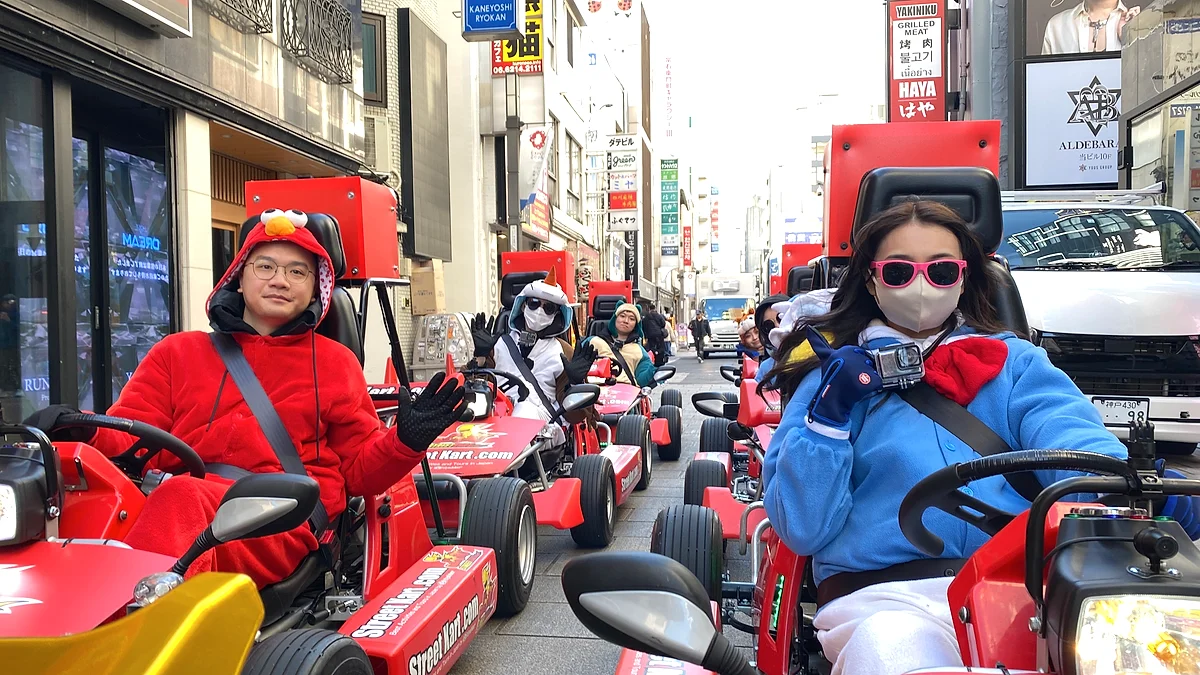
First, how it feels as a ride. Street karts have no roof and sit low, so your eye level drops well below normal. The wind hits your face, and the sounds of the city come straight to your ears. Even the streets of Minami-Horie look a little different than when you're walking. Signs you always looked up at feel even taller. Being able to fit both Osaka on foot and Osaka from a kart into one trip is the reason to build this tour in.
Second, a guide leads the way. Every tour has a trained guide who drives in front and manages the route. You don't need to find your way with a map. Just following the guide's back down the road is a fairly unusual kind of moment on a trip.
Third, tour-day guidance is basically in English. Guidance in Japanese or other languages depends on the staff that day, so it can't be guaranteed. If you need guidance in a language other than English, try asking in advance through the official website. The website itself is available in 22 languages.
Fourth, the store's location. It's close to the stations, a 3-minute walk from Nishi-Ohashi and 5 minutes from Yotsubashi, and both Amerikamura and Shinsaibashi are within walking distance. Being able to link your plans before and after on foot is a real help when you're putting the trip together.
Fifth, small conveniences around the store. There's a restroom inside, and Wi-Fi is available. There's also a convenience store within a 5-minute walk. Little things like these quietly help when you're checking a map before the tour or looking up a dinner spot afterward.
Sixth, its track record. As of November 2023, across all locations combined, Street Kart had run more than 150,000 tours and received more than 20,000 reviews, with an average rating of 4.9 out of 5. These aren't current figures, but they give you a sense of how much experience the service has built up. There are 9 stores in Japan: 7 in Tokyo, 1 in Osaka, and 1 in Okinawa. In Osaka, this single Minami-Horie store is the only place to ride.
Booking and planning for the day
Book early. Weekends fill up quickly. Graduation trips often include a weekend, so it's safest to act as soon as your dates are set. The booking methods and contact details are all on the official website, so choose from there.
Prices vary by season and time of day, and tour length depends on the plan. That's why this article doesn't list prices or durations; the official website is the most accurate source for the latest information.
Driver's license requirements differ by country and license type. Listing only part of them could be misleading, so they're not covered here. Check the official website (kart.st) to confirm whether each of you can join with your license. If it turns out only one of you meets the requirements, your travel plans could fall apart. Before booking, check for both of you together.
One more thing. This article can't tell you about plans or arrangements for special-occasion trips. If you're curious, check the official website. In the end, what your trip celebrates depends on how the two of you plan the time before and after the tour.
Remember your milestone trip in your own words
Graduation and a new job seem to pass by as a matter of course when they happen. But open the photos a few years later, and it all comes back: which streets you walked, where you ate, what you talked about. Street karting is one block of time at the center of a trip like that.
Before, walk around Amerikamura and meet up at Triangle Park. Then see the same city again from a kart. After that, look up at the signs in Dotonbori and ask each other across the griddle, "So when are we meeting next?" That's really all the planning you need. Minami will welcome the two of you with its usual lively buzz.
If you're going on a weekend, it's a good idea to check availability once your dates are set. Tour details and booking are all on the Street Kart official website. Once you've decided which block of time to free up in your plans, get in touch through the site.
This article was originally written in Japanese and translated using AI. Some expressions may read unnaturally, and we appreciate your understanding. For the most accurate and up-to-date information, please refer to the official site at kart.st.
Street Kart is not affiliated with Nintendo or the Mario Kart series in any way. We do not provide costumes of Nintendo characters, and such costumes may not be worn during tours even if brought by participants.